题目情境#
题目链接:https://www.luogu.com.cn/problem/B3637 ↗
题目描述
给出一个由 个不超过 的正整数组成的序列。请输出这个序列的最长上升子序列的长度。
最长上升子序列是指,从原序列中按顺序取出一些数字排在一起,这些数字是逐渐增大的。
输入格式
第一行,一个整数 ,表示序列长度。
第二行有 个整数,表示这个序列。
输出格式
一个整数表示答案。
输入输出样例 #1
输入 #1
6
1 2 4 1 3 4输出 #1
4算法解析:#
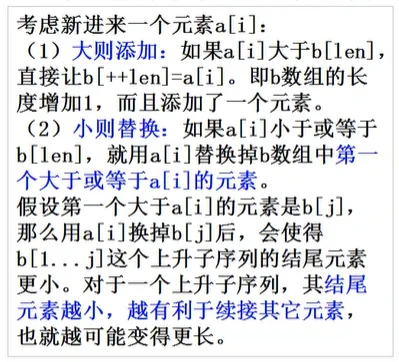
LIS 最长上升子序列: 表示长度为 的上升子序列的最小末尾值。遍历每个数 ,用二分在 中找第一个 的位置替换(若 大于所有则追加), 的长度就是 LIS 长度。严格上升用 ,非严格用 。复杂度 。
Python代码实现#
import bisect
n = int(input())
b = [0] * (n + 10)
a = list(map(int, input().split()))
b[0] = int(-2e9)
len = 0
for i in range(n):
    if b[len] < a[i]:
        len += 1
        b[len] = a[i]
    else:
        b[bisect.bisect_left(b, a[i], 1, len)] = a[i]
print(len)C++代码实现#
#include <iostream>
#include <cstring>
#include <algorithm>
using namespace std;

const int N=100010;
int n, a[N];
int len, b[N]; //记录上升子序列

int main(){
  scanf("%d", &n);
  for(int i=0; i<n; i++) scanf("%d", &a[i]);

  b[0]=-2e9;                              //哨兵
  for(int i=0; i<n; i++)
    if(b[len]<a[i]) b[++len]=a[i];        //新数大于队尾数,则插入队尾
    else *lower_bound(b,b+len,a[i])=a[i]; //替换第一个大于等于a[i]的数(贪心)

  printf("%d\n", len);
}